
Are elite speed puzzlers born or made? What do the top speed puzzlers have in common? These questions and more are explored in the podcast Piece Talks, which focuses on discussions with competitors, organizers and puzzle makers in the competitive jigsaw puzzler world.
Joyce Yoo interviewed the host, Rob Shields, and he shared what he's learned after speaking to 30-40 guests about what it takes to be a high-performing speed puzzler. Rob also revealed what goes into being a commentator on a speed puzzling livestream and shared some stories of major moments in competitive puzzling.
Read on to learn more about Rob, speed puzzling and puzzling events!
Or scroll to the bottom to watch the full video interview.
[Interview has been edited for length and clarity.]
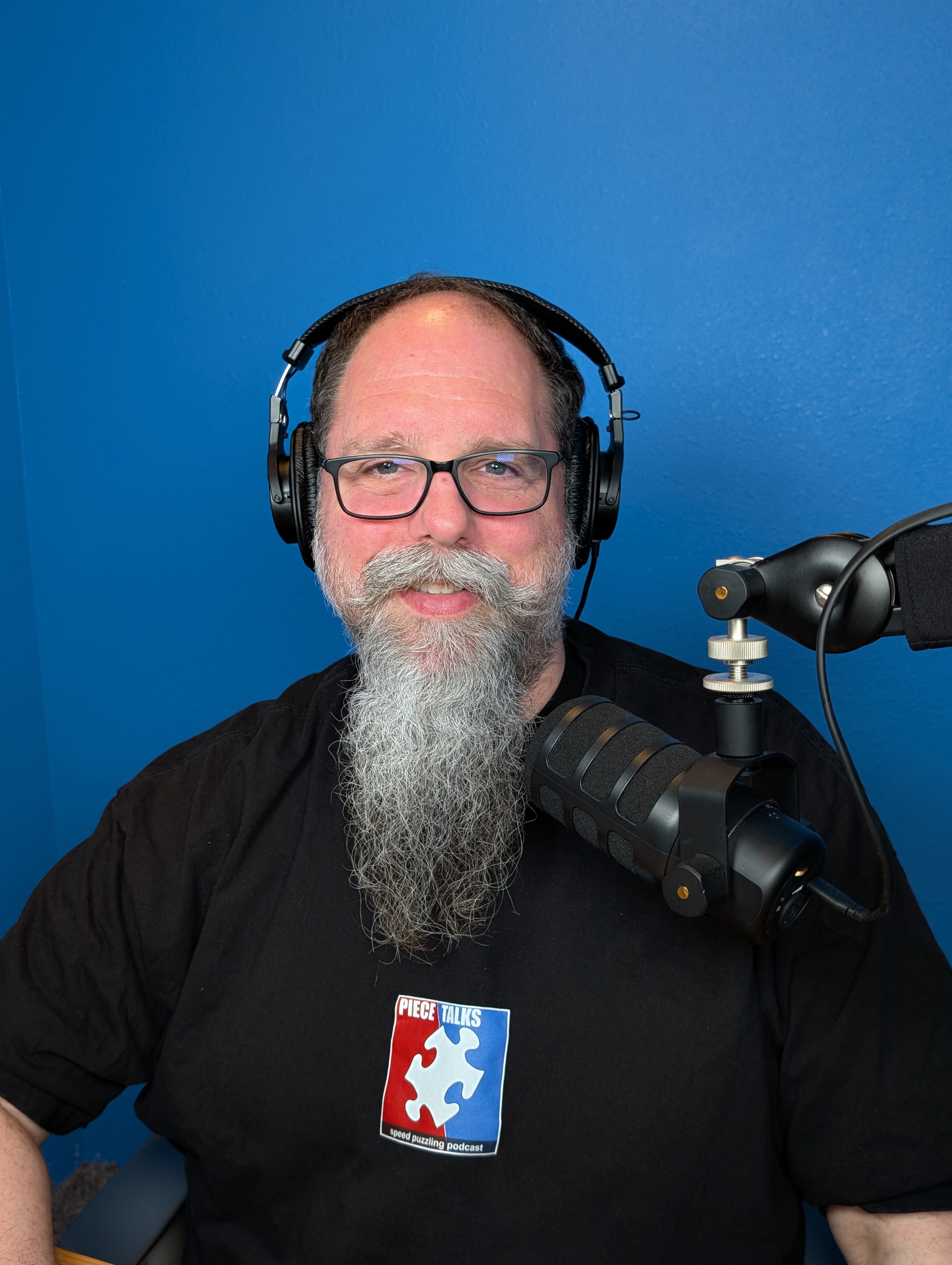
I am a mediocre puzzler who has aspirations for being a less mediocre puzzler, and one of the ways that I thought that I might be able to improve my puzzling would be to talk to people who are actually non-mediocre puzzlers - which is to say, some of the world's best puzzlers.
So I started a podcast. I reached out to Andrea Peng, who I had no relationship with. I was just like, “Hey, I'm doing this new thing, would you be interested?” And she was like, “Absolutely!” And away I went talking to people.
It's a podcast focused on who the interesting people are in the puzzling world, what they do, how they think about things. It’s anything related to speed puzzling, so it's competitors, it's manufacturers, it's people who put on events.
It has been my joy to talk to 30 or 40 different people all across the competitive jigsaw puzzling scene who've been willing to lend me some of their time so that I could share it with everybody else.
My wife and my daughter and I were casual jigsaw puzzlers. Once every month or two, we'd bust out a 1,000-piece puzzle and work through it over the course of a day or two. And always in the back of my mind, there was some idea to time it and see how we do, and because it's fun and I like optimizing things, it's just another thing to optimize.
I had previously looked for competitive jigsaw puzzling things, like, “Is that a thing?” I never found it, but one day, my wife and I were reading A.J. Jacobs’ The Puzzler book, all about different kinds of puzzle experiences that he had. Somewhere around Chapter 6 is jigsaw puzzling and he mentions going to the 2019 World Jigsaw Puzzle Championship as the only representative from the United States. And my wife and I were both like, “This is a thing?”
We looked it up, and the first U.S. Nationals event was happening the very next month. So we were like, “We need to start practicing and working through some process and some strategy.” So we went from casual puzzlers to intense competitive speed puzzlers almost overnight.
When I talk to the world's most accomplished competitive jigsaw puzzlers, the thing that I did not expect to find is how much being the world's best, or the nation's best, or even the local’s best competitive jigsaw puzzler is a mind game. How much of that is not necessarily perfecting your technique, not necessarily perfecting your communication with your partner. But how much of it is really dealing with your inner demons, especially in solo versions because it's just you and the puzzle. You need to work through your feelings of inadequacy, your concerns that other people are watching you, or whatever it is. Those things really become intense in a way that I had no idea.
I was expecting to primarily talk about practice, technique and things like that. And we do talk a fair amount about those things. But the thing that keeps coming up over and over again is how much you need to kind of work on getting the voices in your head in sync with how you want to puzzle.
Even the most calm, staid person who is moving deliberately and has a solid face, those people have emotional turmoil going on inside of them that you don't see and they're like, “Oh yeah, I was a wreck the entire time.”
I was talking to Kristin Thuv, world champion a couple years back, and she mentioned that in maybe her first competition, she had accidentally touched the bag that the box was in, and the instructions were don't touch the bag. And despite nothing coming of it, the whole time in her head, she was like, “I touched the bag, I screwed things up.” And if you watch her, she is just calm personified, right?
When I first talked to her and a couple other people, I was like, “Oh, this is sort of unique to these people,” but no, it is extremely common. So that is what I was really surprised to find.
One of the things I was hoping to learn is that, if you're a mediocre puzzler like myself, that there is a path for you to achieve greatness. And while I do believe that that is true, much like anything else, you don't practice to become Usain Bolt. You sort of are Usain Bolt, and then you practice. You're not the world's fastest sprinter because you practiced really hard - there's more to it than that.
So, the best in the world practice hard, practice intentionally, explore their options, work on their mind game, work on making sure that they are fed and watered at all the right times. They do all of the things.
But they are also endowed with a certain set of intrinsic capabilities or traits that allow them to be the best in the world, which in retrospect, makes a lot of sense. But when I was first exploring competitive jigsaw puzzling, I was hoping, “Gosh, maybe I'll be one of those people who can, with the right strategies and the right practice, become really good at it.
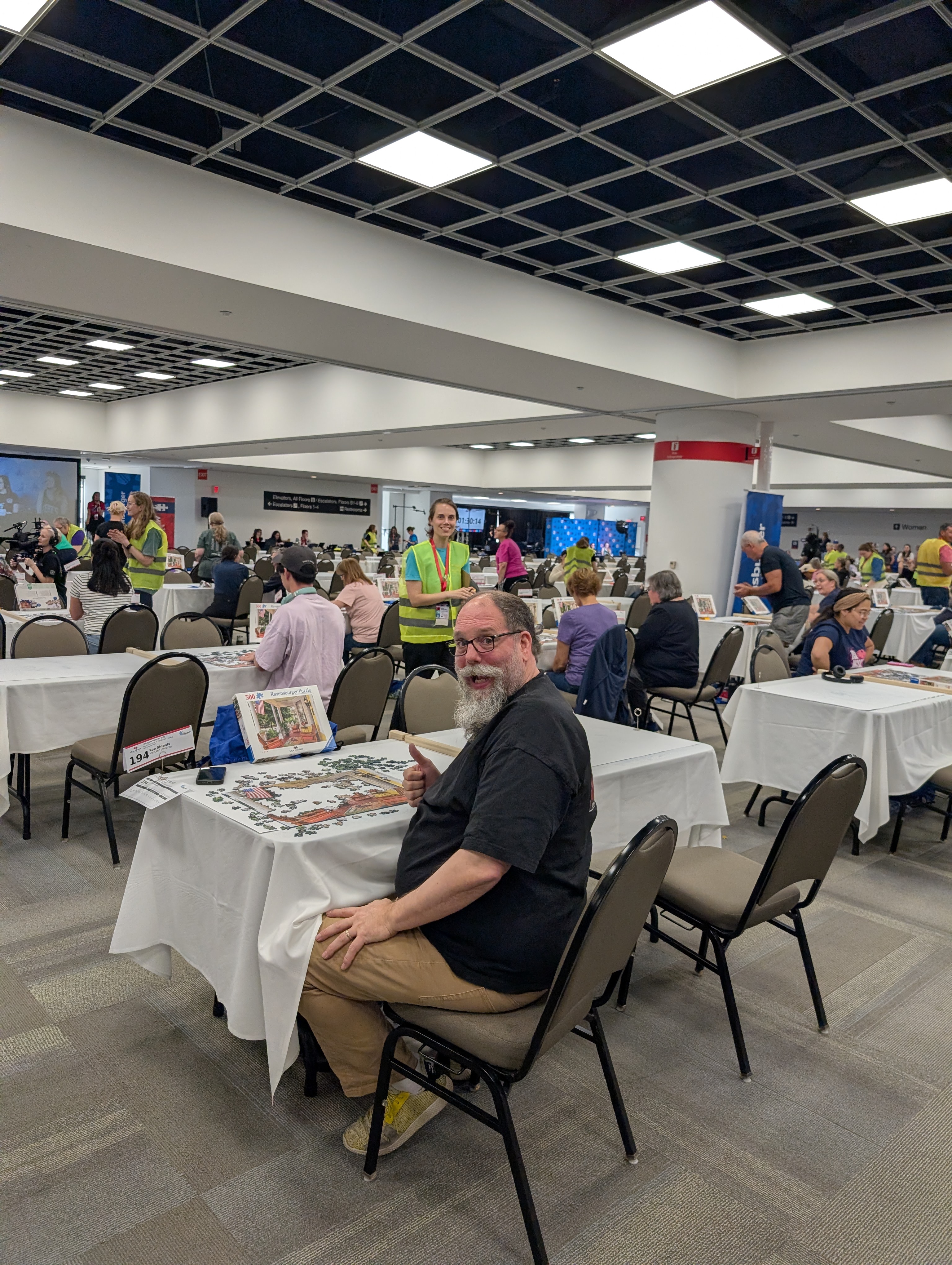
You can definitely improve, no doubt about that. Even the best people improve very substantially. The challenge is, everybody else has improved as well. So what we are seeing is that it can be a lot of effort to stay where you are, because the rest of the tide is rising.
This is the one key takeaway. As an individual puzzler, especially if you're not an elite puzzler, set your goals against yourself, not the rest of the world. Because you may improve your times, but you may struggle to surpass the people around you because they're doing their thing
So as long as you're doing better, it is more healthy for you to set your goals relative to yourself than to set it against everybody else.
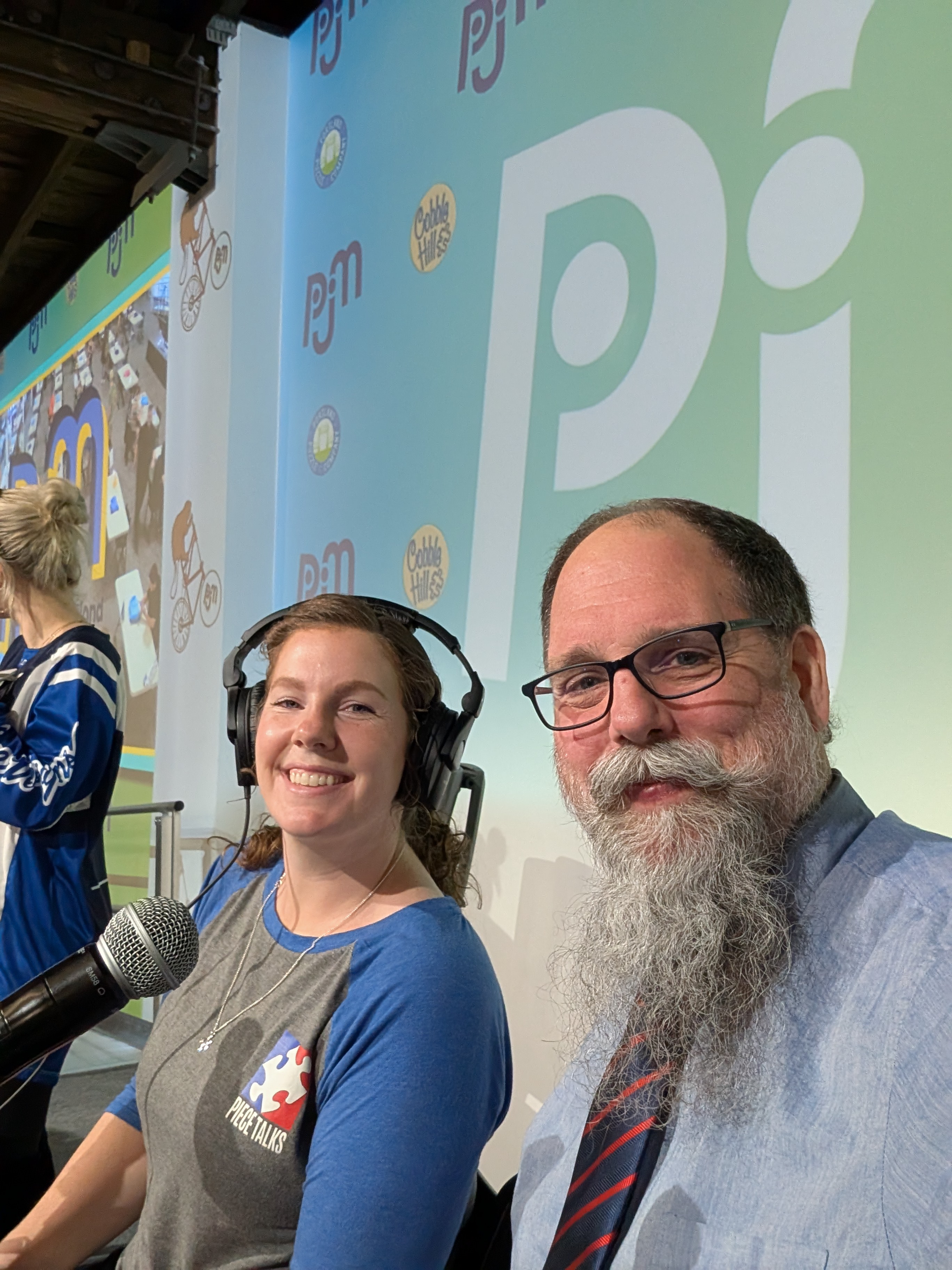
The first Portland Jigsaw Masters, 2024, was my first time doing the live commentary at a live streamed competition. It was on the back of that I ended up doing some commentating for the following year's Nationals, and then Worlds, and then this year's Nationals. And then Portland Jigsaw Masters in the middle of there somewhere else as well.
Fortunately for me, the Portland Jigsaw Masters is in the town in which I live. I happen to know the people who are there, and they're like, “Hey, you talk about puzzles. Do you want to talk about puzzles on a live stream?” So they invited me along.
I had a lot of trepidation going into that. Is this something I can do? It helps that I have a lot of excitement and passion and curiosity around that sort of thing. Especially if you have a co-host, there's only so bad you can do. Somebody else is gonna help carry you along. So I was fortunate enough that it worked out.
There is a fair amount of just reminding myself of what's going on, getting up to speed with who's gonna be there, what kinds of things they have done. But also, one of my abiding passions is data analysis. That's another reason that I'm into the podcasting side of things, because I like data, and podcasting is a way that I can use that data.
I generally have a laptop with information around who's there, some basic stats if I need to reference it. It's actually more for me to remember who's got certain sets of skills, who are the most likely capable people out there.
On the podcast, we started doing “who to watch at Nationals,” and that was really the brainchild of EB Caron, who is a great puzzler and a good commentator as well. She is enormously plugged into the network of puzzlers. She will come to a conversation about who to watch with enormous amounts of personal insight around people that I don't have any idea how she gets.
Then I think mostly what you'll see us looking at is the map of who's at what table. It continues to be the bane of competitive jigsaw commentators to understand who you are looking at because often all you see is some hands.
One is that the stats don't matter as much. Now, it really depends on the competition. For Portland Jigsaw Masters, I have a lot of control over that, because it's sort of my baby, whereas U.S. Nationals and Worlds, I have less control over, and you want to fit into how they do some things.
Nationals tends to be a lot more storytelling than it is stats-based things, whereas for Portland Jigsaw Masters last year, we actually started 10 minutes before the competition begins to just talk. We treat it like a sport. We talk about, “What do we expect to see?” We also brought in Jacob Pilawa who is a member of the USJPA's JPAR scoring team and a stats guy. He would show us a graph or two.
In any case, I've learned that I need to adapt to those things. Not everybody wants the deep stats, strangely.
Also, my favorite announcer is Jim Eakins. If folks haven't had a chance to listen to Jim Eakins, they really should. “Setting the bar” is not kind enough to what it is that he does in the world of competitive jigsaw puzzle commentating. He raises the bar in the way that NASA raises a rocket. It's so far above and beyond. So I take away from watching him. He brings the energy and enthusiasm and really makes you feel caught up in the moment. Also, he’s relentlessly focused on giving praise to the people on the screen.
The competitive puzzling world is super nice to begin with so the default is to say nice things, but Jim is an amazing reminder that there's always depth to what you can bring to that kind of conversation.
One of the many exciting portions of Worlds was the weather and the fact that the climate control inside the Millennium Dome was not really functional. So, it was a physical trial being in there, definitely for the competitors, but also for the commentators. Jim Eakins and Michelle Kasper, who founded Euro Jigsaw Jam, were in there for multiple sessions, back-to-back-to-back-to-back, often with not a lot of chance to rehydrate and refuel. And it was very hot.
There was a Teams round where the weather turned from being hot to being less hot, but also raining like you needed an ark. And hail and wind. All of this weather was happening. There's a big screen outside that fell over because of the wind. This is a mild Armageddon sort of feel to it.
And then the power goes out. But it's in this dome, which is basically a plastic shell, so it lets a lot of light in. So I'm not sure that most of the puzzlers even noticed that the power went out.
I happen to have connected my laptop so I can look up stats and things. I connected it to my phone to get connectivity out of the building because I had previously experienced earlier in the week, that the internal Wi-Fi could get really jammed, so I wanted my own connection.
So I hopped on my laptop, connected to YouTube, and the feed was indeed down, but the chat was still going.
And this happened right at the point where the elite teams are starting to move from the first puzzle to the second puzzle. People really want to know who's moved over into the next puzzle and what puzzle they moved over into.
And it happened that I was sitting looking right at one puzzler and they just moved over, so I typed into the chat that this team has just moved over. And people are like, “Oh, I love that team, that's great!”
I had been sitting with Michelle who had been the host at the time, and we had one guest, Sergio, who was just about to leave and a new guest, Veronika, who was just about to come on. Michelle had gone walking away to look and see how things are going. And I typed in updates she brought back. At some point, Sergio and Veronika were like, “Well, we can help with this.” So they started going off into the audience and coming back and bringing me information to type into the chat.
We never read the comments because we were too busy feeding information into it, but as a person who loves spectating on competitive jigsaw puzzling, and a person who has had people that they love involved in the competition and want to know how they're doing, I would love to know this thing, and there's no other way of getting it right now.
So it didn't take very long for us to start doing that. It wasn't necessarily that we thought about it, but all four of us just immediately started falling into various roles of providing that information.
At some point, the power comes back on, and the clock had been on for a little while - they fixed that problem pretty quick. And the livestream got up and running. I am still, to this day, not sure that very many puzzlers ever noticed that anything was going on. Some of them didn't even notice the hail that was banging on the roof!
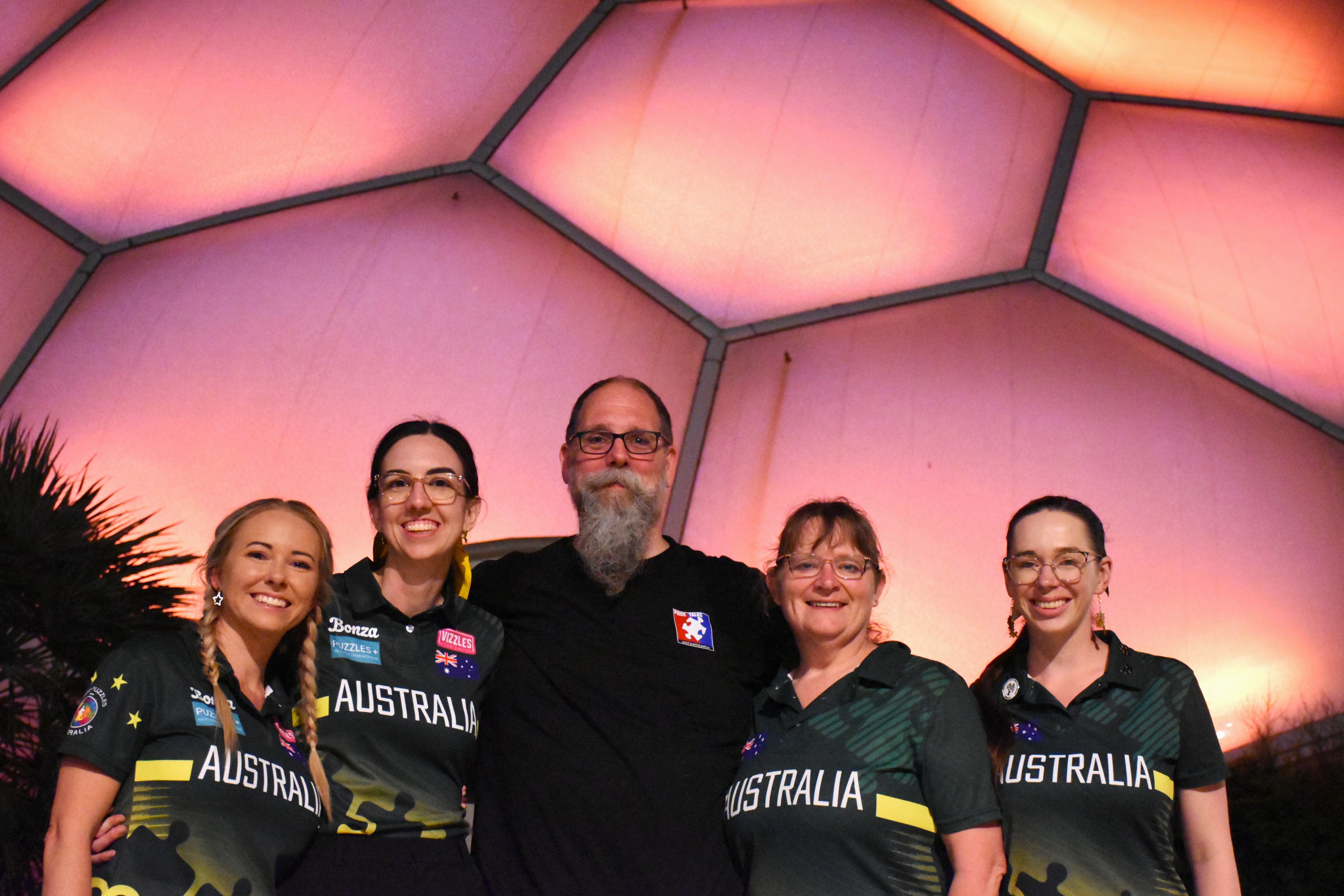
I think the only thing I can say is go check out Piece Talks. If you’re into the world of competitive jigsaw puzzling, we talk in nerdy depth about everything that we can talk in nerdy depth about. If you're doing a puzzle, it's great background to have.
But really, the people that I talk to and the people in the jigsaw puzzling community in general are just uniformly amazing. They're interesting, they're quirky in their own ways, they're thoughtful. So go listen to Piece Talks, not because you'll be listening to me, but because those people are amazing.
I would especially say to listen to the one that I did recently with Lauren Kautz. She is so much fun. In that episode, she is just a blast. She is hilarious and a lot of fun to listen to. So I would say go listen to her, but all of the people are amazing.
Go talk to the people in your puzzling community. They're all amazing. And you're probably amazing if you're watching or listening to this, so people should talk to you as well.
- On Apple Podcasts
- On YouTube
- On Spotify
- On Audible
- On Listen Notes
- On iHeart
- Piece Talks on Instagram
- Rob on Instagram