
Puzzles for the blind? Dishwasher safe puzzles? Yes, they exist! The Puzzled Co is a father-daughter duo that creates unique puzzles including waterproof puzzles, tactile puzzles with textures, puzzles with braille, magnetic puzzles and more.
Their mission is to make puzzling more inclusive and accessible - and fun!
Joyce had a chance to interview Gabriel ("Gabe") Einsohn, one half of the family team behind The Puzzled Co, and dug into how much heart, thought and collaboration goes into making their puzzles.
Read on to find out how The Puzzled Co is changing the puzzling game!
(Or scroll to the bottom to watch the video interview.)
[Interview has been edited for length and clarity.]
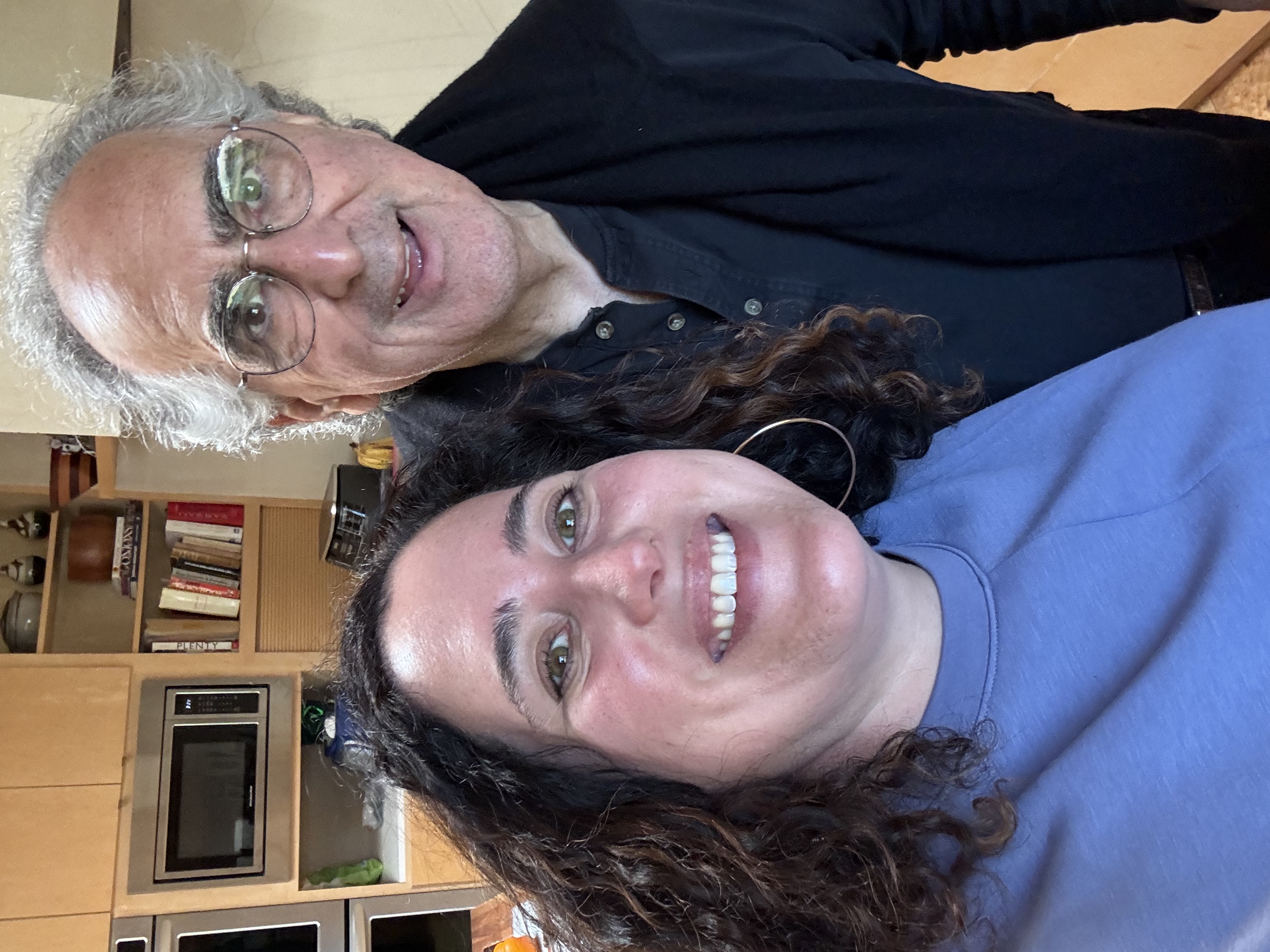
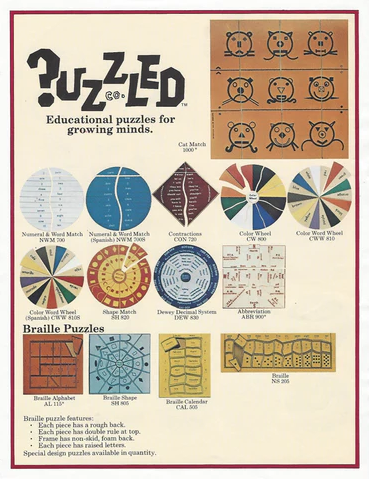
We’re a family duo, with me and my dad. My dad actually started The Puzzled Co in 1977 when he was a hippie kindergarten schoolteacher in Austin [Texas]. He was hand cutting his own puzzles for his classroom since they didn’t have puzzles.
Then he noticed that there were really no puzzles for people who are visually impaired. So he's actually maybe arguably the first person to put braille on puzzles for kids. And that’s a precursor to where we’re at now.
They actually stopped the company in 1980 when I was born because they moved to Dallas, and then his career went on a totally different path doing production, and then it ended up in this water jet design area.
In the pandemic, my dad came back to me and said, “Hey, you've moved on from your art museum work, do you want to kick up The Puzzled Co with me again?” And I thought, “Well, you know, I kind of owe you, Dad, because I was born right at the time and you had to change your company.”
So we started the company in 2020 because a dear friend of ours said, “You know, puzzles are coming back and you all have the capability of cutting your puzzles with water, so you could actually make a product that's highly sanitizable.”
So we sort of started from this wood, hand-cut puzzle land, and now we use a water jet machine to cut our puzzles.
You put a CAD file in, it reads the file, and it does its thing. It has a nozzle where a stream of water shoots out. We can get very precise cuts and shapes. So it's about a 50,000 PSI stream of water. So that's essentially the width of one hair. It's a whisper, but it is so powerful. Your pressure washer that you do on your driveway is like, nothing. This will cut your arm straight off if you get near it.
We got a tactile printer, so now we do full production in Dallas, Texas, which is where our company is. I live in Austin. We do everything in-house. We buy our PVC from someone who is right down the street from us.
We print everything in-house, we do all of our design in-house, and I have been leading the way as the art director and also making a lot of artworks myself for fun. And then we collaborate with other artists who come in and do art editions and special projects.
So if you're in a classroom setting, you can just rinse these off in bleach water and it will not fade the coloring.
We also know that you can put them in the dishwasher. Any puzzle that you own by The Puzzled Co that is PVC - because, again, we make wood, magnetic puzzles - they’ll be alright. The heat from the dishwasher won't ruin the image either.
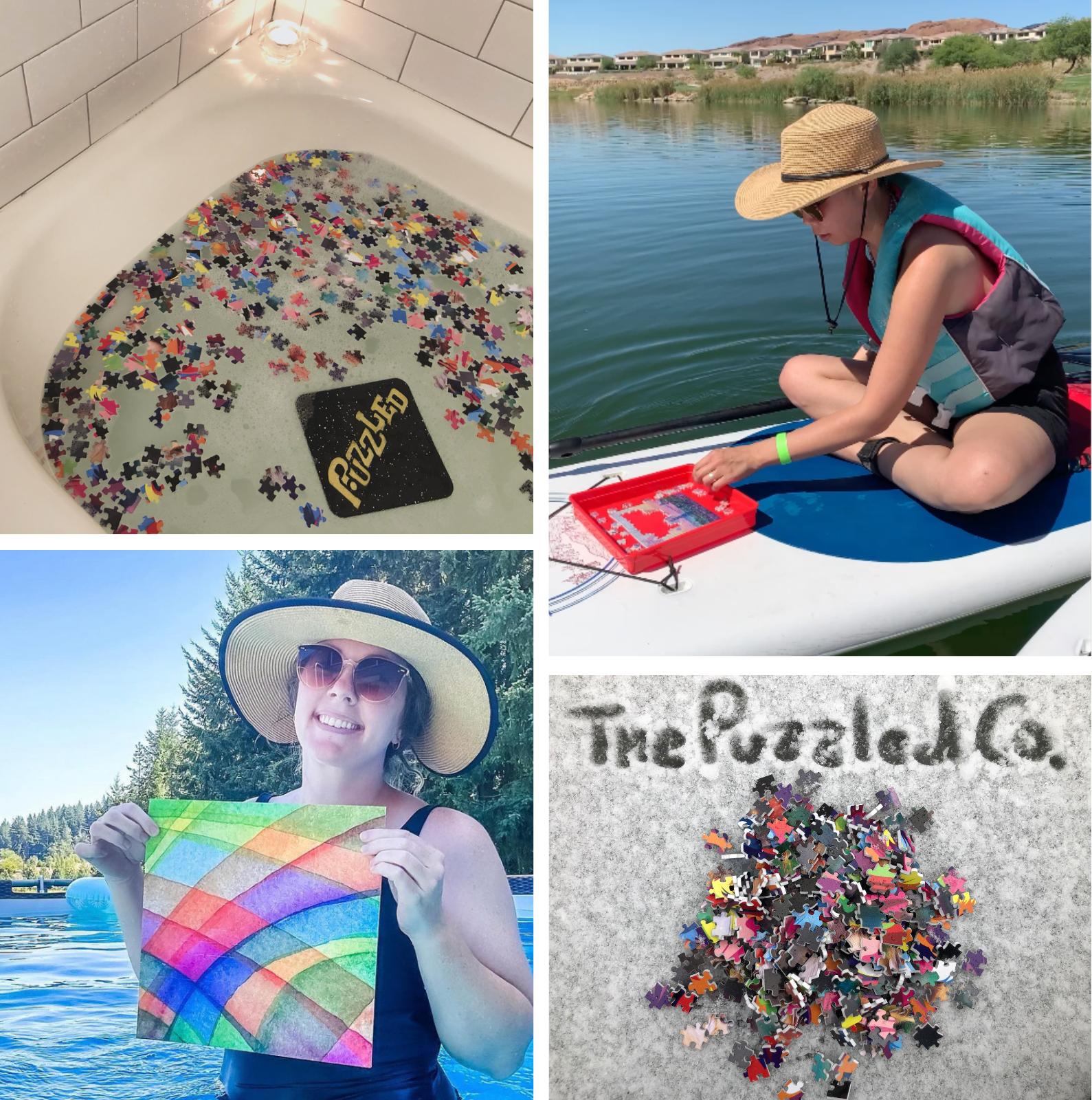
You can puzzle in the bathtub. They actually do stick to the walls of the tub. If you want to sit by the side of the pool and puzzle and drink, you can.
One of our puzzles now lives in Fiji. Someone took a lot of puzzles on their vacation, floated them in the water, and then left them with the hotel so that other people could enjoy them.
You [Joyce] are probably the first human ever to paddleboard and puzzle at the same time.
One time someone made a snowman on top of a puzzle. Someone took a puzzle to the World Jigsaw Puzzle Championship in Spain 3 years ago, so it swam in the Mediterranean. We’ve had somebody go to a river, a little puzzle in a creek. We have a video of just puzzling in a rainstorm.
If you just put a little bit of painter's tape on the back of the puzzle, then it becomes a coaster for the side of your table. It's also fun to take the puzzles that are bigger and use them as interactive placemats.
So first, I have to give a shout out to Brian and Completing the Puzzle. We met at a speed puzzling competition in Fort Worth and he really changed my life and our business by introducing us to American Printing House for the Blind.
And that is so special because it's incredibly important to our business and has informed the direction it's gone in. Because when we started, we were trying to figure out who we were. Are we a whimsy people? Are we wood? Because we can cut wood, too, and magnet. So we can do all these things, but who are we?
This partnership with American Printing House for the Blind has really pushed us in the direction of being, I think, unique than any other company. We do hold some world records for some of the things we do and that's been exciting. It's much more complicated to produce our puzzles.
Right around when we met Brian, we were starting to make these tactile puzzles with the intent that everyone could use them. Everybody wants to touch things. So the puzzle is for everybody.
Our goal is: it doesn't matter who you are, can you sit down with one of our puzzles in a mixed group of people - maybe someone's colorblind, someone's got low vision, someone wears glasses, someone is fully sighted, maybe someone's fully blind - how can we make a puzzle that everyone can enjoy?
We know that puzzling is awesome solo. It is good for our brains, it's good for our hearts, and it brings down our blood pressure and all sorts of amazing things, helps the mind keep fresh in our older years.
We would like for people who are visually impaired to also be able to experience the joy of puzzling holistically. Sitting down with friends, having a beer, having a puzzle night - and these don't exist for this community.
So, by working with American Printing House for the Blind, which has been creating things for this community for over, like, 180 years, we've learned about the types of things that make a good puzzle.
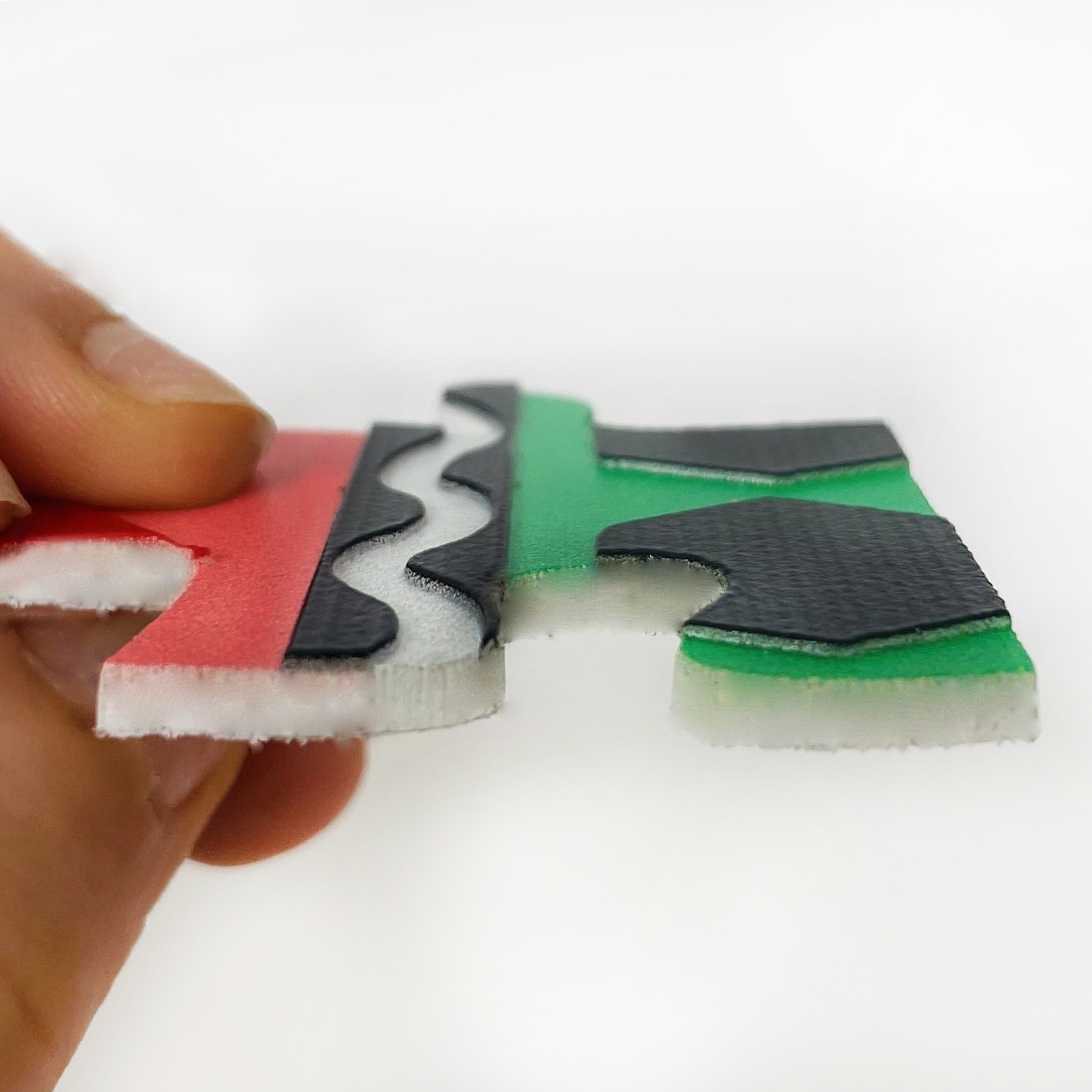
Black PVC. Black is a helpful contrast. We think at first: white. White has the most contrast. To us, yes. But not to somebody who's visually impaired.
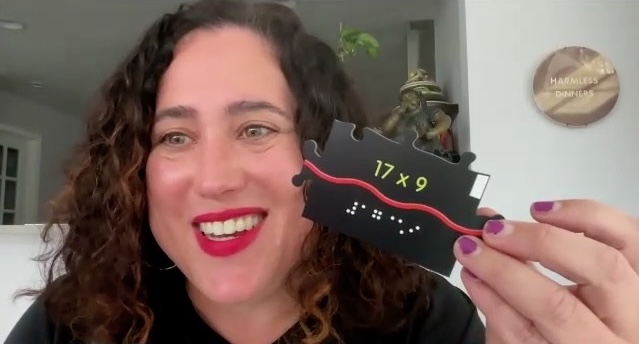
An important thing about designing for people who are visually impaired is you need a braille indicator, a tactile indicator. Every puzzle piece of ours is going to have a raised, tactile line. It tells you that this is a tactile puzzle, and hey, braille is coming. It's a standard ADA [Americans with Disabilities Act] thing and it helps with general orientation.
A tactile wavy line across the piece is an indicator of the horizontal orientation of the puzzle piece. We use large print - 12 to 13 point font - for low sighted puzzlers. This is not tactile. And then we have braille which is tactile.
The puzzles come with a two-piece guide puzzle that you fit together first and that is like your box top. So you use it to sort.
Additionally, each piece has unique fittings, so that if you don't get the right fitting, you don't have the right answer to a math problem, for example. So, it's self-reinforcing.
It means that all of our puzzles are going to give people the opportunity to play by themselves, but also work with others in a learning environment. We have these tactile art puzzles and the majority of our business with APH is K-12 educational puzzles.
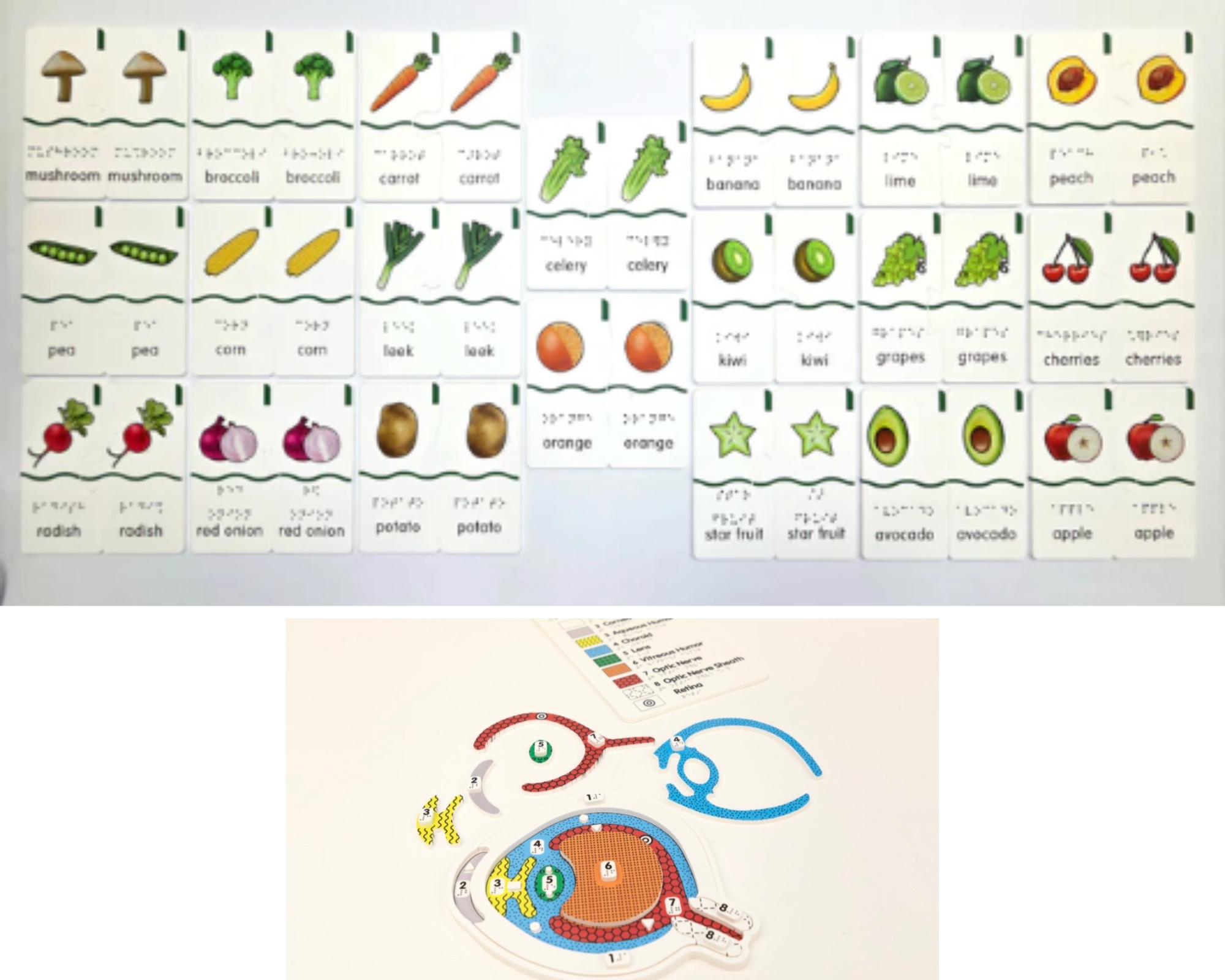
As sighted people, there are assumptions we make and things we don’t realize. One of the hardest things we did was, we created a memory matching game. Two pieces, very simple, fit together. So, matching bananas.
Okay, how do you take and make a banana graphic that looks like a banana, because we're puzzles for everybody, so a visual experience is important. Then also feels kind of like a banana, because you want a tactile experience and something that translates as a flat banana to a person who has never seen a banana.
You can feel the shape, so that's really important. So we did a whole matching game of fruits and vegetables that we created tactile graphics of these fruits and vegetables.
Something really beautiful that we invented with APH this year is called the My Sight puzzle. It is a puzzle in the shape of an eye and each of the parts of the eye are a puzzle piece. Each of them has a different texture to indicate the part of the eye and there's a key or legend know that says “cornea” and has squiggly lines next to it or “retina” with dots, so we assigned a tactile pattern to each section in order to help with sorting.
It has the educational part of learning about the eye but also, through this puzzle, these kids and adults can also explain to other people about their visual impairments. They can use it as a source of power.
Yes, and our puzzles have been field tested by more than a thousand students, teachers, etc. These puzzles meet federal quota eligibility.
So for people whose job it is to buy puzzles and awesome games for classrooms, there is federal money that they can use to buy these for their schools and classrooms. Also, lending libraries similar to Completing the Puzzle, they have these in each state.
So if you're a teacher out there, and you didn't know about this, you can also go to your state, your school, and they have a state representative, and you can request our puzzles for your classrooms every year.
It's been a really interesting journey to try to design for all these different people and entities, but the tactile puzzles are really great and we have seen a shift in our business.
We were included in the most unique puzzles video that's gone around, which I'm also very grateful for, because moments like this, the opportunities that you're giving me and other companies have given me to talk about our tactile puzzles have resulted in a really big uptick in sales.
And that's not about us making money, because they're really, frankly, we don't really make money off that. But it's about access in our community. Word of mouth is powerful and I know the community that we're in cares so much about inclusion.
So it feels really nice that people are giving us space to champion this slightly non-traditional bit of our practice.
I would say the majority of the people who buy our tactile Puzzles for EveryBody™ without the braille are low vision puzzlers or puzzlers who have started to lose their sight due to age.
This is a big deal right now, because we're all living longer, we are trying to be healthier longer, we have more devices to assist us with living and keeping our vision. But at some point, for all of us puzzle people, it's going to get a little harder.
So we want the joy of puzzling to extend to all ages. We find that most of our tactile puzzles are bought for people’s grandparents.
The best way for me to know how to design is if people just tell me what they want. If y'all have people in your lives that are visually impaired, if there's, like, a favorite puzzle that your grandparent always does and they just can't do it anymore because they can't see, let me know, and I'll remake it a version of it.
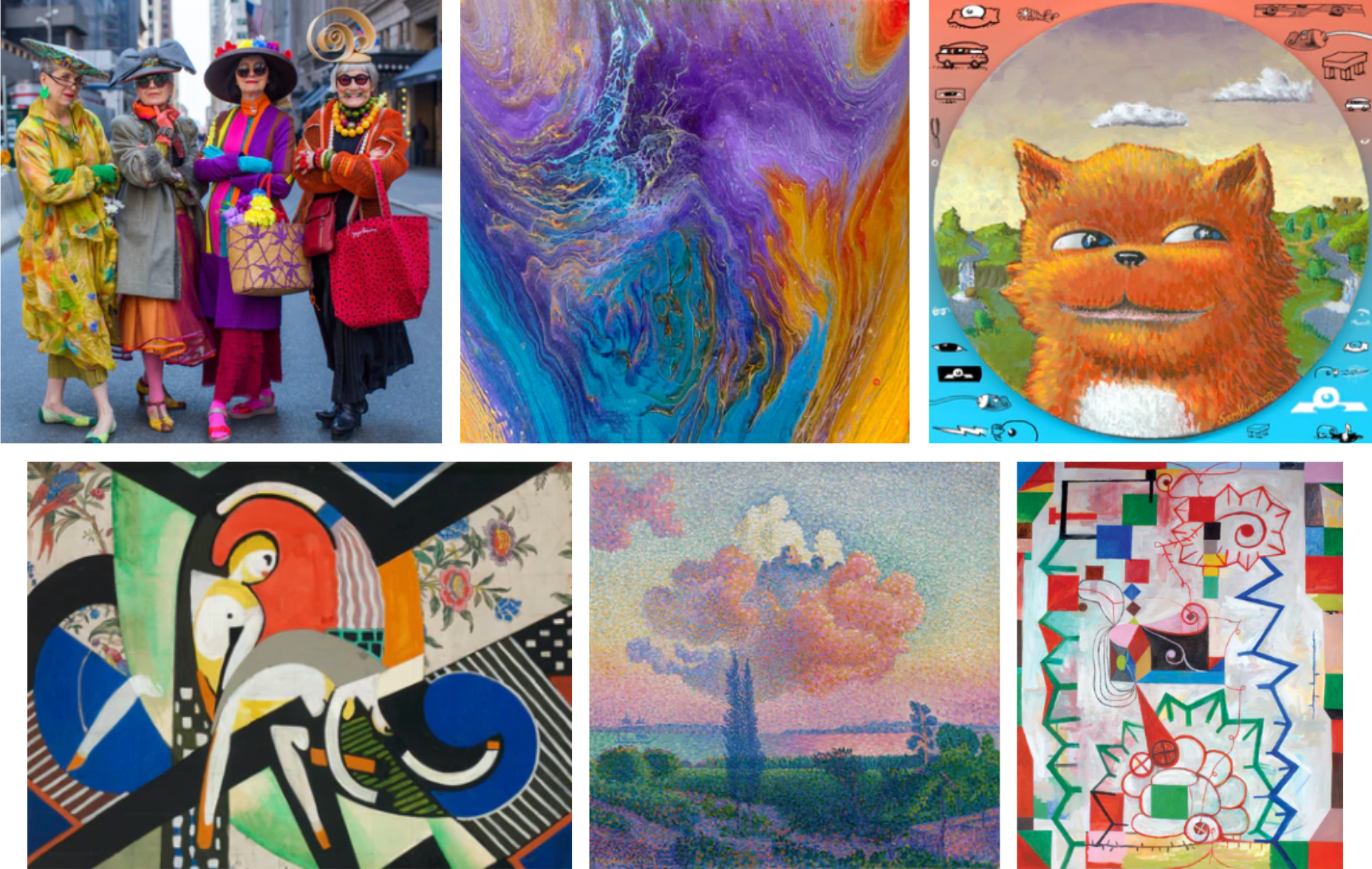
We're a small company, so I need people to come to me and tell me what brings them joy. I'm a contemporary art person so I've gone really heavy on pulling things from the Smithsonian, and sometimes that works, but people want flowers and pretty things and patterns. We have all of those available.
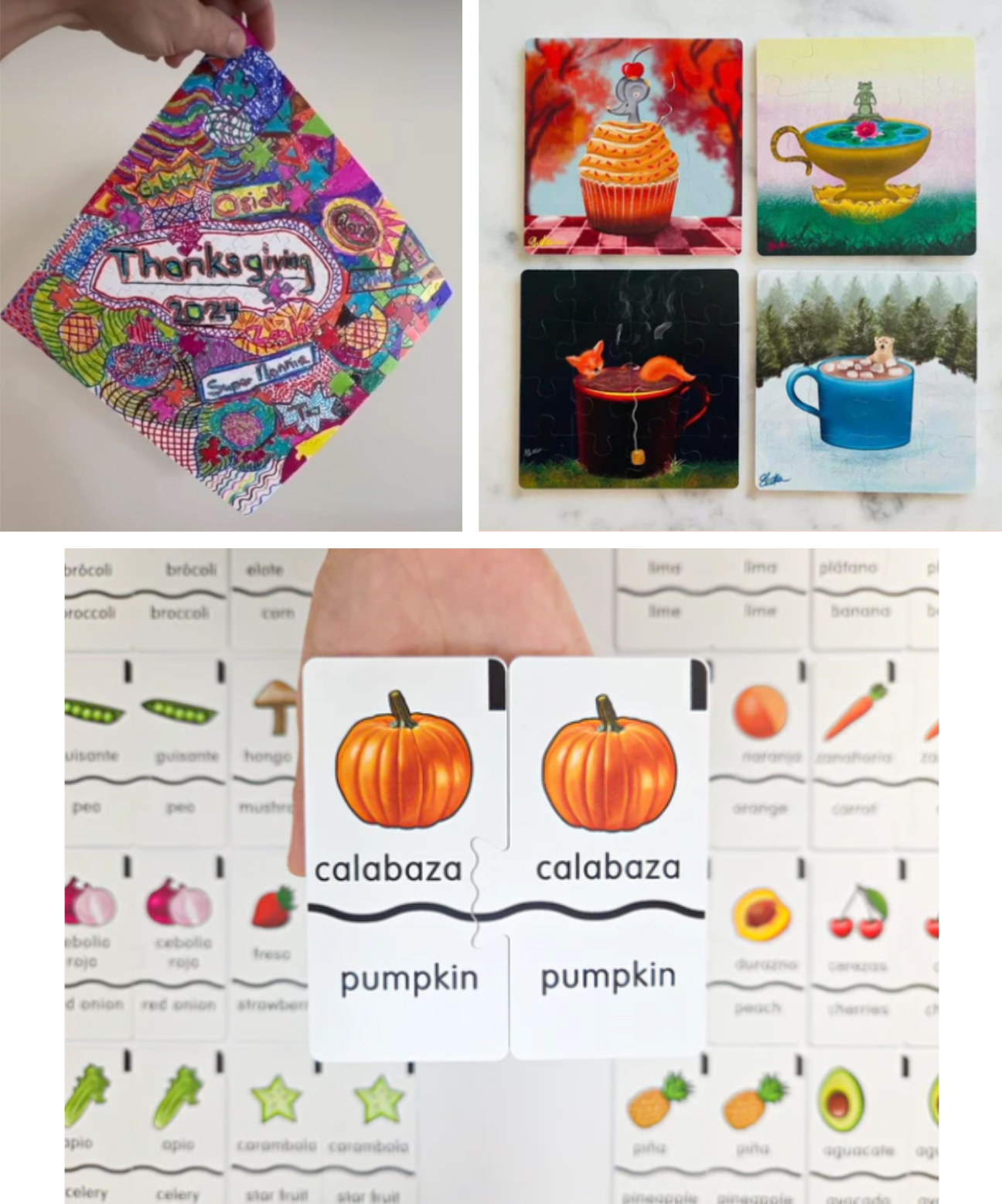
You can make your own art on the back side of the puzzle. They’re white PVC on the back and it’s the same quality as on the front. Paint may stain a little tiny bit of the edge because the PVC is a little porous.
We’ve seen people use permanent markers and draw on the back and make their own second puzzle, a two-sided puzzle. Or they write a note to the person that they want to gift it to on the back.
We do make puzzle coasters, a set of 4 coasters, 16 pieces each and we put all the pieces in the same bag. So it is a social activity. You pick your art - there are 4 unique artworks - and then you sort as a group and find your pieces. It's great for parties, like a party favor.
We can print everything pretty much on demand so if you want to send us your picture, we can make these coasters for your loved ones or an event.
We have a lot of things in English and Spanish, actually. We are in Texas, so that's important for our community here.
We're grateful. We couldn't do what we do without everyone. I want to do a major, serious shout-out to every single person who's created content with our puzzles, including yourself.
Because small businesses, this is how we exist. We simply do not have the budget to pay people to do the things, so the only way that we have grown is by people showing up for us, and it takes time and energy and creativity to think of how to make these puzzle videos.
I acknowledge it and I'm grateful because we couldn't get here without people getting really curious, wanting to play, and being generous enough with their time to invite us to join.
Thank you!